Emotion and Power in Watercolors

Winslow Homer - The Blue Boat (1892) [Public Domain courtesy of WikiMedia Commons]
Emotion and Power in Watercolors
Watercolors are often seen as a delicate medium—transparent, fluid, and requiring precise control to avoid unintended bleeds or muddiness. Yet this very fragility becomes a strength when artists harness it to evoke deep emotion and convey raw power. The unpredictability of water allows for spontaneous effects, luminous layers, and atmospheric depth that can stir awe, tension, introspection, or primal energy. Techniques such as wet-on-wet blending create ethereal moods, while bold contrasts, saturated pigments, and expressive dry brush strokes transform subtlety into intensity, turning the medium's lightness into a vehicle for profound feeling.
Building on our exploration of sense of place in watercolor from the previous post, let's delve deeper into how these masters transformed watercolor's inherent challenges—its transparency, fluidity, and demand for decisiveness—into strengths that evoke the sublime forces of nature and human experience. I'll draw parallels to oil painting techniques, where dramatic contrasts, painterly strokes, lighting, and composition were key, and highlight how watercolor requires a more intuitive, less forgiving approach to achieve similar emotional depth.
Here are several masterful examples of watercolors that demonstrate how this seemingly gentle medium can pack emotional and powerful impact.
J.M.W. Turner's The Blue Rigi, Sunrise (1842)
Turner masterfully used watercolor to capture the overwhelming power of nature, often evoking awe, melancholy, or exhilaration through his command of light and color. His techniques included loose, translucent washes that blended sky, water, and land into ethereal forms, reserving the white of the paper for luminous highlights to create dramatic value contrasts. He applied quick, intuitive brushwork to suggest movement and ephemerality, building layers of color to intensify mood without rigid details. This approach conveyed power through implication—the fury of storms or the quiet dominance of landscapes—stirring emotions by immersing viewers in atmospheric drama.
In watercolor, unlike the buildable opacity of oils where you could layer thick impasto for texture or glaze for depth, Turner's method relied on spontaneity; mistakes couldn't be easily overpainted, so he embraced the medium's flow to evoke emotion through subtlety and suggestion rather than bold physicality.
This iconic watercolor captures the moment before dawn on Lake Lucerne, with Mount Rigi emerging in glowing blues and soft pinks. Turner's masterful use of translucent washes and subtle gradations conveys the sublime power of nature's light, evoking a profound sense of awe, serenity, and the overwhelming beauty of a fleeting sunrise. The delicate layers build an almost spiritual intensity, showing how watercolors can make the ephemeral feel monumental.
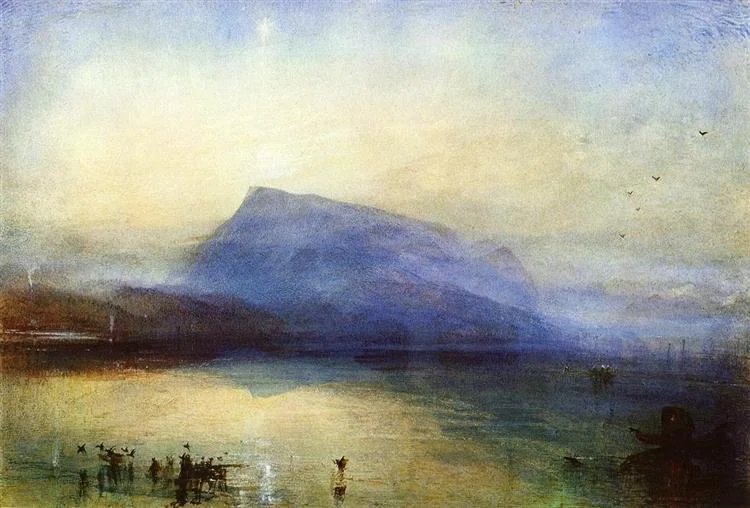
J.M.W. Turner's The Blue Rigi, Sunrise (1842) [ Public Domain courtesy of WikiArt ]
Winslow Homer's The Blue Boat (1892)
Homer conveyed the relentless power of the sea and wilderness in his paintings, evoking emotions like isolation, resilience, or exhilaration through direct, observational techniques. He employed wet-on-wet blending for fluid transitions in waves and skies, bold value contrasts to heighten drama, and layered washes to build texture without overworking the paper. His limited palette and spontaneous strokes captured movement—crashing surf or gusting winds—making scenes feel alive and immersive, often placing human figures as small elements against nature's dominance to amplify emotional tension.
Compared to oils, where painterly brushstrokes and dramatic lighting could be refined over time, Homer's watercolors demanded immediacy; the quick-drying nature forced decisive marks, evoking emotion through raw energy rather than meticulous buildup, though both mediums share a reliance on contrast for impact.
In this serene yet powerful scene, two figures glide in a small boat amid reflective waters and reeds. Homer's fluid brushwork and shimmering blues create a sense of quiet vastness and contemplative solitude, where the transparency of watercolor enhances depth and the subtle movement of water, turning an everyday moment into one of introspective strength and nature's gentle dominance.
Winslow Homer - The Blue Boat (1892) [Public Domain courtesy of WikiMedia Commons]
William Blake's The Ancient of Days (1794)
This visionary work (from Europe a Prophecy) shows a godlike figure reaching down with a compass, symbolizing creation and limitation. Blake's bold colors and dynamic composition—achieved through relief etching enhanced with watercolor—radiate divine authority, mystery, and philosophical tension, stirring deep existential emotions and a sense of cosmic power.
_British_Museum.jpg)
William Blake's The Ancient of Days (1794) [Public Domain courtesy of WikiMedia Commons]
John Singer Sargent's Muddy Alligators (1917)
Sargent captured the vibrant power of places and light, evoking wanderlust, serenity, or intrigue with rapid, confident techniques. He drew directly with the brush, mixing flat washes for broad areas with agitated, gestural strokes for detail, and used opaque gouache sparingly for highlights. Vibrant hues and edge variations—hard for focus, soft for mystery—created shimmering effects, conveying emotional immediacy in urban or natural scenes.
Unlike oils, where dramatic color contrasts and brushstrokes could be blended wet-into-wet over hours, Sargent's watercolors thrived on speed and unforgiving transparency; emotion emerges from the medium's lightness and flow, making power feel lively and poetic rather than heavily constructed, though both leverage lighting and composition for narrative pull.
Sargent depicts a group of alligators lounging in Florida mud with loose, expressive strokes and earthy tones. The watercolor's fluidity captures latent menace and humid atmosphere, evoking visceral unease, respect for wildlife's primal force, and raw natural power.

John Singer Sargent's Muddy Alligators (1917) [Public Domain courtesy of WikiMedia Commons]
Winslow Homer's Three Fisher Girls, Tynemouth (1881)
Young girls search for shellfish on a windswept English beach in this poignant scene. Homer uses watery grays and blues to convey the sea's harsh power alongside human resilience, creating empathy and admiration for their determination against the elements. The medium's delicacy contrasts beautifully with the figures' strength.
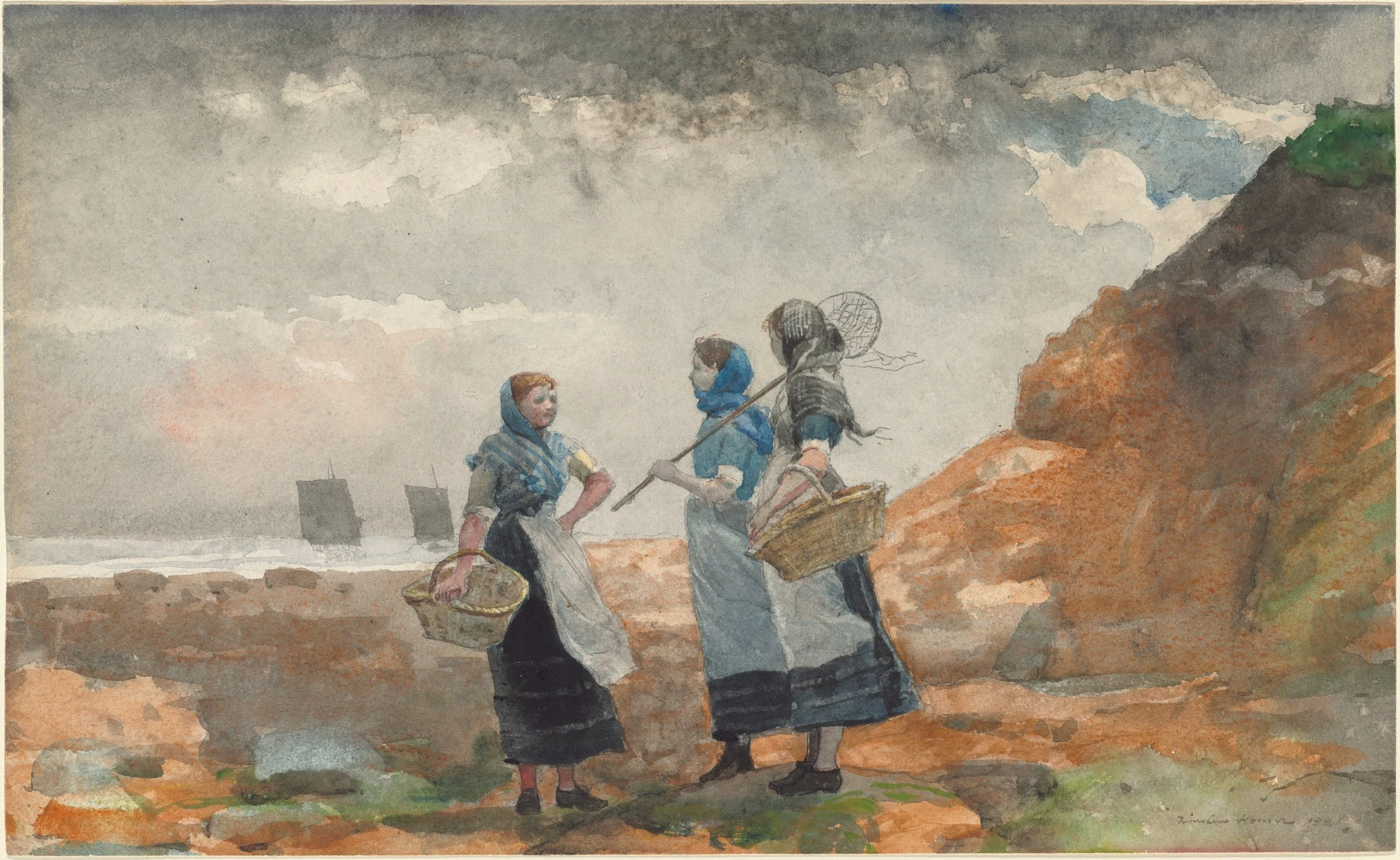
Winslow Homer's Three Fisher Girls, Tynemouth (1881) [Public Domain courtesy of National Gallery of Art]
These works show that watercolors are far from fragile in spirit—they can capture light, mood, and emotion with extraordinary force. By embracing the medium's unique qualities, artists turn transparency into transcendence.
How Watercolor Differs from Oil in Evoking Emotion: Insights for These Masters
Oil painting emphasizes dramatic color/value contrasts, painterly strokes, lighting, and composition—tools that allow for forgiveness and texture-building. Watercolor, as these artists show, flips this: its transparency demands planning (e.g., reserving whites instead of adding them later), and quick drying pushes spontaneity, evoking emotion through subtlety and flow rather than opacity. Turner and Sargent used washes for atmospheric lighting, akin to oil glazing but more ethereal; Homer's watercolor contrasts mirror oil’s value work but rely on layering without blending back in. Overall, watercolor's "unforgiving" nature fosters a raw, intuitive power, where emotion feels captured in the moment, differing from oil's deliberate buildup yet equally potent in compositional storytelling.