Why Your Watercolors Feel Flat (and How Hofmann's Push-Pull + Texture Fixes It)
John Singer Sargent, “Fog above lake Garda at San Vigilio”, 1913. [Courtesy of Wikimedia]
If your watercolor paintings sometimes come out looking pretty but a little lifeless—like they’re sitting there on the paper instead of breathing and moving—you’re in good company. A lot of us hit that point where the colors are nice, the composition is solid, but the whole thing just doesn’t spark. The fix isn’t another new technique or fancy pigment. It’s understanding how everything works together as one living system: Hans Hofmann’s Push-Pull theory, its deep roots in Cézanne, and the way mark making, texture, lost-and-found edges, and value create real dynamic tension on a flat sheet of paper.
Where Push-Pull Came From
Hans Hofmann (1880–1966) was a German-American painter and one of the most important teachers of the Abstract Expressionist generation. He didn’t invent the idea out of nowhere. Around 1907 in Paris, he soaked up Paul Cézanne’s work and never forgot it. Hofmann later credited Cézanne with understanding color as a “force of push and pull” that creates volume—breathing, pulsating, expanding, and contracting—without traditional perspective.
Cézanne’s patchy, constructive brushwork in those famous still lifes and Mont Sainte-Victoire landscapes builds form through color relationships, visible strokes, and value contrasts rather than smooth blending. The marks respect the flat canvas while suggesting real depth. Hofmann took that insight and pushed it into full abstraction, always honoring the two-dimensional picture plane while making it feel alive with opposing forces.
Cézanne:
![Paul Cézanne, Mont Sainte-Victoire [Courtesy of Wikimedia]](https://commons.wikimedia.org/wiki/File:Paul_C%C3%A9zanne,_Mont_Sainte-Victoire.jpg)
![Paul Cezanne, oil painting, “Still Life with Apples” [Courtesy of Wikimedia]](https://commons.wikimedia.org/wiki/File:Still_Life_with_Apples,_by_Paul_Cézanne.jpg)
What Push-Pull Really Means
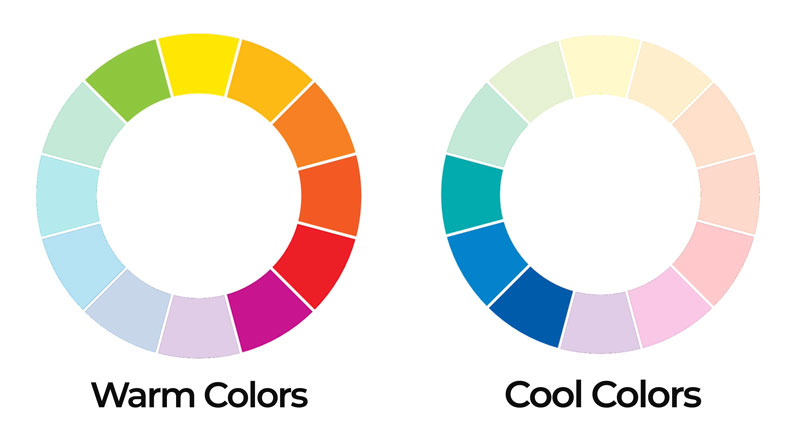
Hofmann first put the term in print in his 1948 essay Search for the Real. In simple terms: every “push” (something advancing, expanding, coming forward) needs a balancing “pull” (receding, contracting, going back). Warm colors, bold textures, hard edges, or lighter values often push; cool tones, softer areas, darker values, or lost edges pull back. But it’s bigger than any one element—it’s the full dance of shape, scale, placement, surface quality, value (light/dark), and edges. “Push is answered with pull, and pull with push.” The whole surface stays active; nothing falls dead.
Value is a key (and sometimes overlooked) player here. Strong contrasts between light and dark create spatial tension and drama. A light area surrounded by darker values can pop forward (push), while a darker passage against lighter ones can sink back (pull). Hofmann understood that color creates light, and value relationships amplify the plasticity—making the painting feel dimensional and alive even on flat paper. Without thoughtful value play, even beautiful color can feel flat.
Warm vs Cool Colors illustration (value + temperature in action):
Hofmann works to study (still under copyright—view at museums and websites):
Hans Hofmann _ 124 works: https://www.wikiart.org/en/hans-hofmann/all-works#!#filterName:all-paintings-chronologically,resultType:masonry
BAMPFA holds the largest collection: https://bampfa.org/program/push-and-pull-hans-hofmann
Making It Happen in Watercolor
Watercolor is actually perfect for this even though Hofmann mostly painted in oils. The transparency and fluidity let layers interact and show through, creating that pulsating feeling he loved.You achieve push-pull by thinking in relationships rather than isolated elements:
Warm, juicy marks + lighter values push forward energetically.
Cool, soft washes + deeper values pull back into atmosphere.
Big gestural areas counter delicate linear ones.
Every new layer (and its value) answers what’s already there.
Mark Making: The Engine That Drives It
Mark making isn’t just “your style”—it’s your personal handwriting that activates the whole surface.
Hofmann used brushes, palette knives, direct pigment, and whatever created the right energy. In watercolor we get to play even freer: credit cards or plastic scrapers for crisp lifts and geometric strokes, twigs or bamboo for directional lines, dry brush, salt, splatters—anything that introduces variety.
A sharp scraped mark (often with strong value contrast) can aggressively push against a soft wet-in-wet bleed.
That contrast is pure push-pull.
Texture, Atmosphere, and Value: They’re Not Separate
Texture, atmosphere, and value are completely intertwined — they feed each other and feed the push-pull dynamic.
Texture comes straight out of your marks. Rough, dry-brush, or scraped areas catch the light and advance toward the viewer (especially when you pair them with lighter values). Smooth glazes or lifted passages feel softer and recede, creating breathing room (especially when paired with deeper, cooler values).
Value — the range from light to dark — is the quiet powerhouse that amplifies everything else. A light, textured mark will push forward with real energy because of its value contrast against darker surrounding areas. A deep, soft wash pulls back not just because it’s cool, but because its lower value lets it sit farther in space. Without good value contrast, even the most beautiful textures and atmospheric washes can flatten out. Hofmann understood this: value relationships help create the plasticity — that sense that forms are turning, advancing, and receding on a two-dimensional surface.
Atmosphere isn’t just “misty background.” It’s the overall spatial mood and emotional feeling that emerges when marks, textures, colors, values, and edges all dialogue with one another.
The gestalt — the whole greater than the sum of its parts — is what makes the painting sing. When these elements work together instead of in isolation, the surface starts to vibrate with life.
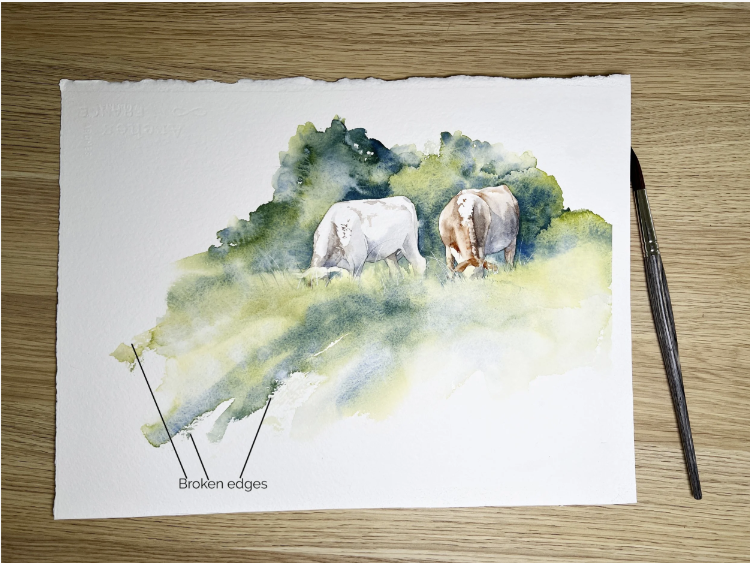
In Sargent’s watercolors below notice how varied marks, value contrasts, textured dry brush, soft atmospheric washes, and broken edges create living push-pull tension on a flat sheet of paper.
![John Singer Sargent, “Mountain Stream” (c. 1907–1911) [Courtesy of Wikimedia]](https://commons.wikimedia.org/wiki/File:Mountain_Stream_MET_15.142.2.jpg)
![John Singer Sargent, “Fog above lake Garda at San Vigilio”, 1913. [Courtesy of Wikimedia]](https://commons.wikimedia.org/wiki/File:John_Singer_Sargent_-_Fog_above_lake_Garda_at_San_Vigilio_1913.jpg)
Lost-and-Found Edges + Value: The Rhythm Makers
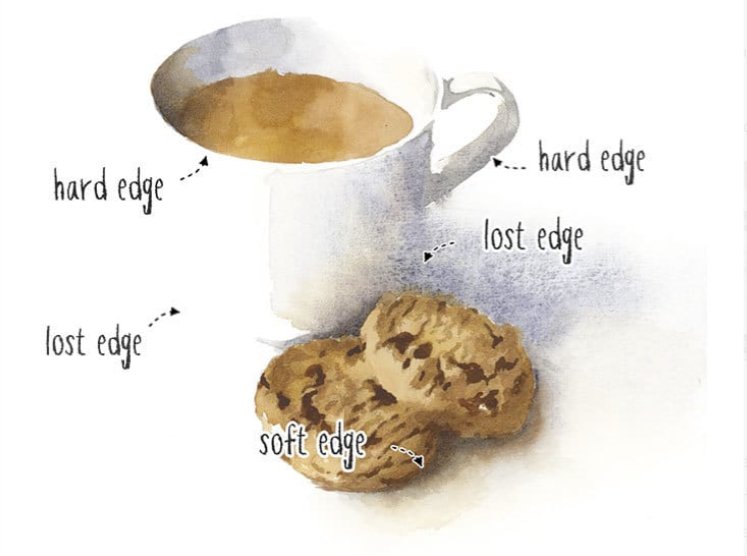
Edges are powerful carriers of tension:
Hard/found edges (often paired with strong value contrast) advance and hold attention.
Soft/lost edges recede and let the eye travel.
Lost-and-found edges (varying along the same contour) guide movement, prevent static outlines, and keep energy flowing.
Value makes edges even more dynamic—a hard light edge against dark can snap forward dramatically.
Try This Simple Studio Exercise
Start with a loose cool wash (deeper values) for atmospheric pull and breathing space.
Add warm, textured marks with lighter values (credit-card swipes or dry-brush) for forward push.
Introduce directional Cézanne-style patches, play with value contrasts, and vary edges.
Step back and ask: Does the surface feel alive? Is there tension and dialogue between all these forces?
This approach works beautifully whether you’re painting sense-of-place landscapes or more abstract work. It keeps things immediate, personal, and responsive to the energy of what you’re painting.
Hofmann taught that painting is about forces, not imitation. When you start seeing your watercolors through the lens of push-pull—supported by thoughtful mark making, texture, value, and edges—they stop feeling flat. They start to live.
I’d love to hear how this lands for you. Have you tried a push-pull study lately?
Drop your results in the comments if you experiment—I’m always up for seeing how these ideas translate in real paintings.
Further Reading
Hans Hofmann: The Nature of Abstraction by Lucinda Barnes (Editor), Ellen G. Landau (Contributor), Michael Schreyach (Contributor), University of California Press, 2019
Hans Hofmann by Cynthia Goodman , Prestel Pub, 1990
The Search for the Real by Hans Hofmann (1994-05-26) by Hans Hofmann (Editor), Sara T. Weeks (Editor), Bartlett H. Hayes (Editor) , MIT Press, 1967