The Knowledge of a Lifetime: The Ruskin–Whistler Trial and the Pressure to Make Art “Relevant”


In 1878, the American-born painter James McNeill Whistler sued the eminent critic John Ruskin for libel. The case arose from Ruskin’s scathing review of Whistler’s Nocturne in Black and Gold: The Falling Rocket, in which he wrote that he never expected “to hear a coxcomb ask two hundred guineas for flinging a pot of paint in the public’s face.”
The trial lasted only two days, yet it remains one of the most revealing episodes in the history of modern art.

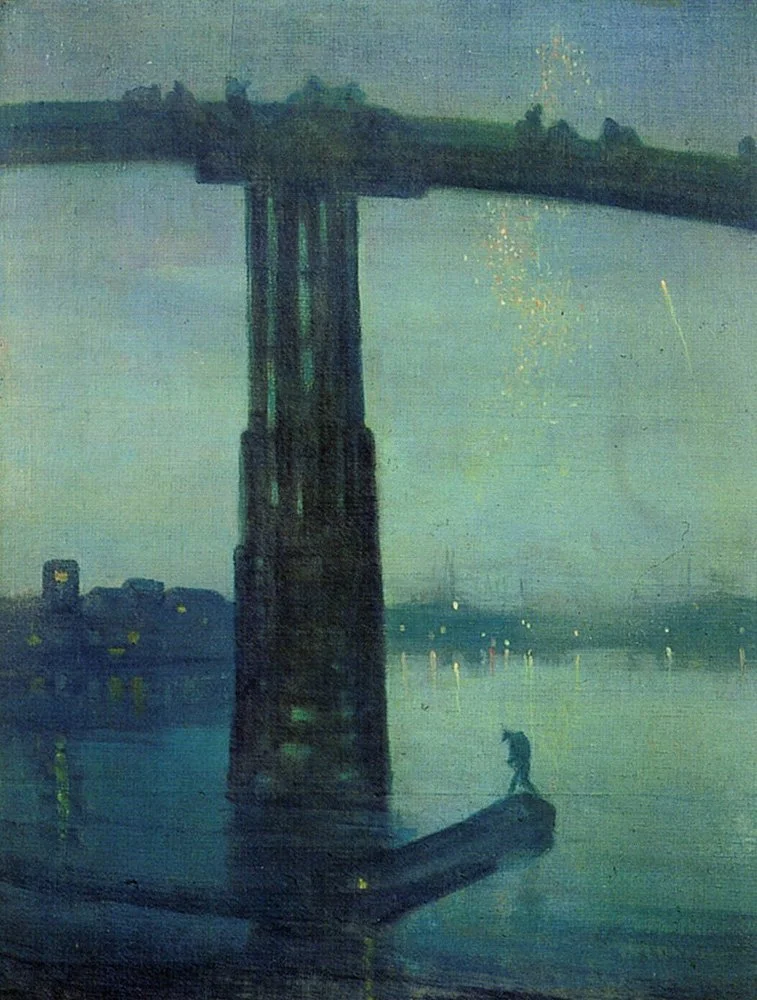
At the time, the dispute crystallized two competing ideas of art’s purpose. Ruskin, the preeminent Victorian critic and social thinker, believed art should be true to nature, morally elevating, and socially useful. The artist, in this view, bore responsibility to the public and to collective progress. Whistler stood for a newer position: art as an autonomous arrangement of line, form, and color, justified by its aesthetic qualities alone—“art for art’s sake.”
The trial became a public forum in which these positions were tested before a jury and a fascinated press.
One exchange has endured more than any other. Asked how long it had taken him to paint the Nocturne, Whistler answered that he had worked on it for two days. The attorney pressed the point: “The labour of two days, then, is that for which you ask two hundred guineas?”
Whistler replied: “No;—I ask it for the knowledge of a lifetime.”
The statement marked a decisive shift in how artistic value could be understood. It rejected the older expectation—still visible in many highly finished Dutch Golden Age paintings—that a patron’s money purchased visible labor, meticulous detail, and the tangible evidence of sustained craftsmanship.
.jpg)
In the Dutch market, finish and complexity often served as proof that the buyer was receiving full value. Whistler’s answer relocated value in the accumulated skill, perception, and judgment of the artist, independent of the hours required to execute a particular work.

Whistler won a technical victory but was awarded only a farthing in damages and no costs.
Both men suffered: Whistler was driven into bankruptcy; Ruskin’s authority as critic was damaged and he soon resigned his Oxford professorship. Yet the larger cultural outcome favored the direction Whistler represented.
The trial helped legitimize the modern artist’s claim to formal autonomy and personal vision. It weakened the assumption that criticism (or society) could dictate art’s moral or social function with near-absolute authority.

That significance has not disappeared.
If anything, it has become more pointed. Over the past several decades, many artists and, more importantly, many institutions—museums, grant-makers, biennials, academic programs, and critical establishments—have increasingly insisted that serious art must carry an explicit social or political message.
The preferred narratives have often been progressive or left-leaning, centered on identity, equity, climate, or systemic critique. Work that declines to announce such a message can be treated as insufficiently “relevant,” “engaged,” or “of our time.”
In this climate, the Ruskin–Whistler conflict reappears in altered form.
Ruskin’s demand that art serve a social purpose finds a contemporary echo in institutional pressure for political commentary, even though the specific values have changed. Whistler’s defense of aesthetic independence now functions as a reminder that art need not be instrumentalized to justify its existence.
The trial’s lasting importance lies precisely here: it keeps open the question of whether art’s primary obligation is to predetermined social utility or to the free exercise of the artist’s hard-won knowledge and vision.
The answer is not that social content is illegitimate. Art has always interacted with the societies that produce it. The difficulty arises when institutional structures begin to treat one form of content as obligatory and others as suspect.
When funding, exhibition opportunities, critical attention, and career advancement hinge on conformity to prevailing political expectations, the range of permissible artistic inquiry narrows.
Whistler’s insistence that the price of a painting rests on “the knowledge of a lifetime” offers a counterweight: the knowledge accumulated through sustained attention to form, perception, human presence, and the world as it is experienced may itself constitute a sufficient, and sometimes more enduring, contribution.

The 1878 trial did not settle the argument once and for all. It simply made the terms clear.
Those terms remain useful whenever institutions press artists to subordinate aesthetic judgment to social messaging. The knowledge of a lifetime is still a legitimate measure of value—and still worth defending.
— Beverly G. McCarter